Last updated: January 2026
Domain-based Message Authentication, Reporting, and Conformance (DMARC) lets domain owners decide how email receivers treat mail that fails authentication. It stops spoofing and keeps outbound email safe. But DMARC can only make the Internet safer if adoption is global. A patchy approach leaves gaps that attackers can use.
Universal DMARC enforcement would:
- Improve cybersecurity: If most domains used quarantine or reject policies, phishing and spoofing attacks would drop sharply.
- Build trust: Real emails would not be wrongly flagged as spam. This protects customer relationships and brand reputation.
- Simplify compliance: DMARC helps organizations meet new cybersecurity rules, such as Microsoft, Google and Yahoo’s Bulk Sender requirements.
- Support collaboration: A global email security standard helps both the public and private sectors. It protects senders and recipients alike.
Positive signs ahead: 2.3 million domains have adopted DMARC since the Microsoft, Google and Yahoo Bulk Sender requirements.
What is the current worldwide adoption of DMARC?
Awareness keeps growing, but DMARC adoption is still low worldwide. As of December 2025, only 14.9% of domains, from a sample of 73.3 million*, have started their DMARC journey. They have a policy of at least p=none (reporting only). There is some progress, with a 5.2% increase since February 2025.
Only 2.5% of domains (around 1.8m) enforce p=reject, the strictest and safest DMARC policy. A striking 83.9% of all domains we looked at show no visible DMARC record at all. This gap shows the urgent need for stronger enforcement and wider adoption. Both are needed to protect businesses and people from email-based threats.
*The sample comes from the world's most used and visited websites.
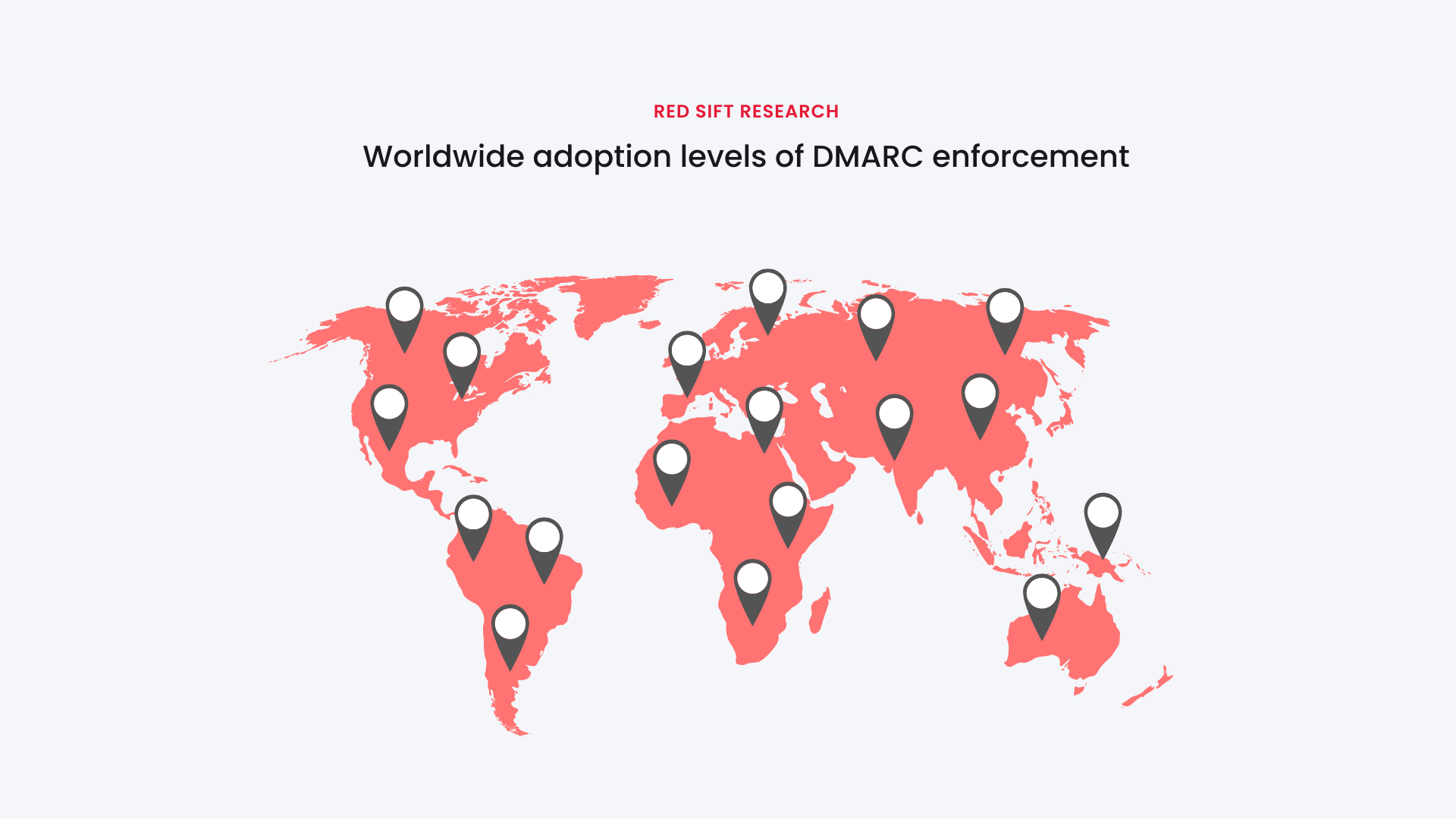
Country vs country: Who is leading the DMARC drive?
Red Sift research looked at 73+ million domains from some of the world's largest public companies, Indices and Regulated groups. The table below shows the largest public companies by country, ranked by DMARC readiness.
Here, DMARC readiness means a domain has the DMARC policy it needs to deploy BIMI (Brand Indicators for Message Identification). That is a policy of at least p=quarantine (send failing mail to spam), if not p=reject (block it).
*Data accurate as of January 2026.
DMARC adoption by country
Expand the table to see all the data
Country | DMARC readiness for BIMI |
United States | 85.9% |
India | 79.1% |
Australia | 78.4% |
The Netherlands | 77.2% |
France | 75.6% |
Canada | 75.3% |
United Kingdom | 75% |
Norway | 68.8% |
Switzerland | 68.1% |
Germany | 67.9% |
Sweden | 67.4% |
Austria | 62.9% |
Brazil | 59.3% |
Spain | 58.8% |
Russia | 58.1% |
Belgium | 56.4% |
Chile | 55.6% |
Taiwan | 54% |
Indonesia | 51% |
Mexico | 47.4% |
Turkey | 46.4% |
Argentina | 46.3% |
Italy | 46.2% |
Peru | 42.6% |
Thailand | 31.3% |
Japan | 25% |
South Korea | 10.1% |
Top public companies have improved since February 2025. In 19 out of 28 countries, DMARC enforcement is now above 50%. The United States, India and Australia show the strongest adoption. Across all tracked public companies worldwide, readiness is 57.6%.
But some countries still have a long way to go. The largest gaps in enforcement are:
- South Korea: Just 10.1% of public companies have reached p=quarantine or p=reject. That's up 4% from a year earlier.
- Japan: Only 25% have reached p=quarantine or p=reject, up 4.3% from February 2025.
- Thailand: Enforcement is just 31.3%, up 4%.
Global adoption is moving in the right direction. But these gaps show the need for stronger efforts from industry and regulators. Those efforts can close the enforcement gap and keep email safe worldwide.
Indices and Regulated Groups
Red Sift data also tracks SEC Regulated Groups, Stock Market and US Market Indices. The table below compares each market or group.
*Data accurate as of January 2025.
Indices and Regulated Groups comparison
Expand for full details
Market or Group type | DMARC readiness for BIMI | Sample size |
SEC Regulated Firms | 30.8% | 14,286 |
CAC 40 | 77.5% | 40 |
DAX | 73.3% | 30 |
Euronext 150 | 66.9% | 148 |
FTSE 100 | 74% | 100 |
FTSE 250 | 65% | 183 |
S&P Pan Arab Composite | 78.4% | 97 |
Fortune 500 | 81.2% | 499 |
S&P 500 | 81% | 500 |
Market indices lead the way in DMARC enforcement. All of them have at least 60% achieving at least p=quarantine. The S&P 500 and Fortune 500 stand out, with DMARC readiness scores of 81% and 81.2%. This shows strong security habits at the world’s largest publicly traded US companies.
But SEC-regulated firms lag far behind. Just 30.8% have reached BIMI readiness (DMARC p=quarantine or p=reject). This gap shows the need for more pressure from regulators and wider adoption across the industry. Both would help protect the financial sector from email-based threats.
Why DMARC should be mandatory
Existing regulatory frameworks
Many countries already have cybersecurity and data protection rules. These rules could be a base for DMARC enforcement. For example:
- General Data Protection Regulation (GDPR): This European Union law stresses data security. It could be extended to require email authentication.
- California Consumer Privacy Act (CCPA): This United States law protects consumer data. That can include sensible, proactive email security steps, such as DMARC.
- Digital Operational Resilience Act (DORA): This EU law requires strong cybersecurity for financial institutions. It includes guidance that recommends DMARC.
- The National Institute of Standards and Technology (NIST) clearly recommends DMARC, SPF, and DKIM to stop phishing and spoofing. Its papers, such as NIST 800-177 and 800-53, stress p=reject enforcement. This makes sure only authenticated emails get delivered.
It’s important to learn the risks and rules that come with DMARC. Understand the role of DMARC in email security.
Mandate for international standards
DMARC adoption has grown steadily. Governments and security bodies around the world now see how it helps stop email fraud.
The Internet Engineering Task Force (IETF) and the Global Cyber Alliance (GCA) have built DMARC standards. The European Cybercrime Centre (EC3) actively promotes DMARC, SPF, and DKIM. (SPF and DKIM are the two checks that DMARC builds on.)
Many governments and regulators now treat DMARC as basic email hygiene, not an optional best practice. Their policies show that authenticated, policy‑enforced email is becoming the minimum. This is most true for public‑sector and high‑risk domains.
- UK and US: In the UK, the Government's Cyber Security Policy Handbook and “Securing government email” guidance require central government domains to use DMARC. They must use it with SPF, DKIM, and TLS protections. In the US, CISA’s Binding Operational Directive 18‑01 requires federal civilian agencies to deploy DMARC at p=reject, along with SPF and DKIM.
- Netherlands and New Zealand: The Netherlands and New Zealand brought in national rules around 2018. These rules make DMARC mandatory on government email domains. They move public‑sector email away from unauthenticated sending. New Zealand has since reinforced this position. Its information security manual now clearly requires government agencies to protect domains with SPF, DKIM, and DMARC.
- Denmark and Canada: Denmark requires all government authorities to enforce DMARC at p=reject on their domains. This helps give Denmark one of the highest adoption rates in Europe. Canada mandates SPF, DKIM, and DMARC for federal government email. It does this through its Email Management Services configuration rules and related guidance.
- Australia: Australia’s government email security guidance recommends DMARC with a p=reject policy for agencies. In effect, this makes it a de‑facto requirement for compliant setups.
Together, these government policies, regulatory frameworks, and inbox‑provider rules tell one story. DMARC has moved from “best practice” to a de‑facto global requirement. It now applies to any organization that needs its email to be trusted and to arrive reliably.
Red Sift recommends:
Partnering with international cybersecurity groups is key to growing DMARC adoption. It also helps fight email-based threats like phishing, email fraud, and business email compromise (BEC).
The European Cybercrime Centre (EC3), set up by Europol, is a leading force in cybersecurity across the EU. It actively promotes DMARC, SPF, and DKIM. It works with police, security experts, and industry partners to cut email spoofing and domain impersonation. EC3 also runs the No More Ransom project, launched in 2016 to fight cybercrime around the world.
Beyond Europe, bodies like the United Nations (UN) and International Telecommunication Union (ITU) could push member states to make DMARC mandatory. This would set a global standard for email authentication and security. Civil society groups also have a role to play. They can push for policies that protect people and businesses from cyber threats. These policies also help keep the internet a safe and trusted place to talk.
Address regional challenges and opportunities
North America
- United States: The U.S. has made major progress in DMARC adoption, mostly in the public sector. The Department of Homeland Security (DHS) mandates DMARC for federal agencies. But private sector adoption lags behind.
- Canada: Canada has also made progress. The Canadian Centre for Cyber Security (CCCS) promotes DMARC adoption.
Red Sift recommends:
Federal mandates should grow to cover private sector organizations. This matters most in critical infrastructure sectors like finance, telecoms, energy, and healthcare.
Europe
- European Union: The EU’s focus on cybersecurity gives DMARC enforcement a strong base. You can see this focus in DORA and the Network and Information Systems (NIS2) Directive. These laws require covered organizations to adopt a wide range of cyber hygiene practices.
- United Kingdom: The UK’s National Cyber Security Centre (NCSC) has been a leader in promoting DMARC adoption.
Red Sift recommends:
To make email safer across Europe, existing EU directives should include DMARC rules. This would drive wide adoption. Funding for small and medium-sized enterprises (SMEs) would help remove cost barriers. It would make DMARC easier for firms that may lack the resources to deploy email authentication.
The UK government also has a chance to lead on DMARC enforcement. It can teach organizations about the benefits. It can also work with the private sector to offer subsidized funding for UK-based SMEs. If DMARC is easier to adopt, both the EU and UK can raise security standards. This would cut phishing risks and protect businesses from email-based threats.
Asia-Pacific
- India: The Indian government has mandated DMARC for its domains. But private sector adoption is still in its early days.
- Australia: The Australian Cyber Security Centre (ACSC) has issued guidelines for DMARC adoption. But there is still no enforcement.
Red Sift recommends:
Governments can speed up DMARC enforcement. One way is to run more awareness campaigns with the public and private sectors.
The UK’s NCSC is a strong example of this approach. It has worked with public and private organizations to drive DMARC adoption. Through its Mail Check project, the NCSC helped UK government agencies and businesses set DMARC to p=reject. This greatly reduced domain spoofing.
Africa and Latin America
- Africa: Many African nations lack the infrastructure and resources to deploy DMARC well. But some sectors, like finance, are improving.
- Latin America: Countries like Brazil and Mexico are making strides in cybersecurity. But they need stronger frameworks for DMARC adoption.
Red Sift recommends:
Developing nations need funding and technical support. With limited resources, it can be hard for them to meet mandatory email security rules. Without proper setup, these regions stay open to phishing, spoofing, and other cyber threats.
International bodies should step in to help. They can give grants, technical help, and training. This helps businesses and government bodies deploy DMARC well. If these resources are easy to get, the global community can build stronger protection in every region. This stops developing nations from becoming easy targets for cybercriminals.
Promote collaboration between stakeholders
Public and private partnerships
Governments, businesses, and non-profits should work together to promote DMARC adoption. For example:
- Red Sift offers free tools like Red Sift Investigate. You can use it to check your DMARC record and other key protocols.
- Global Cyber Alliance (GCA) offers free tools and resources to help you set up DMARC.
- Messaging, Malware, and Mobile Anti-Abuse Working Group (M3AAWG) shares best practices for email authentication.
- The National Cyber Security Centre (NCSC) recently announced changes to its Mail Check services. It is ending DMARC aggregate reporting. Recommended private sector providers, including Red Sift, now provide this service.
Industry initiatives
The healthcare and financial sectors handle highly sensitive data. This makes them frequent targets for phishing and fraud. In 2024, 48% of healthcare organizations and 73% of financial institutions reported phishing attacks. And 61% of healthcare organizations lack proper protection against data breaches.
DMARC helps stop fake emails that pose as hospitals, insurers, banks, and payment providers. This cuts the risk of phishing, identity theft, and unauthorized access. With p=reject in force, only approved senders can use an organization’s domain. This helps prevent fraud, support compliance, and keep customer trust.
DMARC is not just nice to have. PCI DSS v4.0 took effect on March 31, 2025. It requires organizations that handle or process card payments to set DMARC policies to "quarantine" or "reject". This stops email spoofing and improves security. Failing to comply can lead to large fines of $5,000 to $100,000 per month, based on how serious the violation is and how long it lasts.
Red Sift recommends:
DMARC does more than protect you. It also improves email deliverability: real emails reach inboxes, and spam and phishing attempts drop. DMARC helps healthcare and financial organizations manage risk, protect sensitive data, and keep their email secure.
Critical sectors that often face cyber attacks still have many security gaps. The protection is there, but many have yet to act.
Educate and empower organizations
Incentives through Government backed campaigns
Some organizations do not know about DMARC, or lack the skills to set it up. They are less likely to implement without incentives or a push from leading government departments or security centers. So far, only a few national authorities have pushed for DMARC adoption. Examples include:
- CISA (Cybersecurity and Infrastructure Security Agency): Mandated DMARC enforcement for U.S. federal agencies through Binding Operational Directive (BOD) 18-01. Agencies must set DMARC to p=reject to stop spoofing and phishing attacks.
- ENISA (European Union Agency for Cybersecurity): Gives guidance and best practices for DMARC adoption across EU Member States. It stresses the role of DMARC in securing government and private sector email. But unlike CISA, it has no direct enforcement mandate.
- NCCs (National Cybersecurity Centers): The NCSC in the UK strongly backs DMARC enforcement. It gives technical guidance to make email safer across government bodies. Other NCCs mostly promote DMARC awareness and adoption at a national level. They offer tools, training, and advice to help organizations make their email safer. Their approach varies by country, in line with local cybersecurity policies.
Did you know DMARC helps marketers as much as security leaders? Learn how to maximize email marketing ROI with the help of DMARC.
Red Sift recommends:
No single organization can drive global DMARC adoption alone. Collaboration is key. Teaching materials, events, frameworks, and workshops can push adoption across the public and private sectors. If we work together, global DMARC enforcement can become a reality.
Educate through academia
University and industry courses in cybersecurity and computer science should teach DMARC as standard. They should also offer special courses on email security and on how to defend against growing, more advanced attacks. The courses below are available now, though they do not all focus on DMARC:
United Kingdom and Europe:
- SANS Institute: Runs special training events in London. They give hands-on practice in many areas of cybersecurity, including email security.
- OPSWAT Academy: A full program that builds email security awareness and skills. It focuses on threats that come by email and on ways to analyze and secure emails.
- University of Southampton: Offers a "Comprehensive Cybersecurity" course accredited by the UK National Cyber Security Centre. It covers a broad range of cybersecurity principles and may include email security.
Canada and the United States:
- Cisco – Securing Email with Cisco Email Security Appliance (SESA): A hands-on course on how to deploy and use Cisco Email Security Appliance. It protects email systems against threats like phishing and ransomware.
- SANS Institute (US and Canada): Offers courses led by instructors on many areas of cybersecurity, including email security. Courses run in many places across the USA and Canada.
- Texas A&M Engineering Certificate Series: Offers a full Cybersecurity Certificate Series to build cybersecurity knowledge and skills. It is for state, local, tribal, and territorial government staff, private sector staff, and students who use computers or mobile devices every day. The courses are built and run at no cost, thanks to funding from the U.S. Department of Homeland Security (DHS) Federal Emergency Management Agency (FEMA).
Prepare for future challenges
Protecting against new threats
As cyber threats change, DMARC must change too. Organizations need to keep up with new advances in email authentication and security to keep their defenses strong. Industry working groups and lobbyists must keep pushing governments and private sector leaders to make DMARC enforcement a priority.
As technology moves on, cybercriminals find new ways to exploit gaps in email security. Looking beyond DMARC, here are four key areas where stronger enforcement would help users in the future:
- AI-powered threat intelligence with DMARC: Make DMARC enforcement stronger with AI-driven threat intelligence. It spots phishing, BEC, and deepfake email threats in real time. AI insights refine SPF, DKIM, and DMARC policies and block attack routes before attacks happen. Red Sift Radar finds and fixes security issues up to 10x faster. It is available through the Red Sift Pulse Platform.
- Zero-trust email security with DMARC: Make Zero-Trust architecture stronger by pairing DMARC enforcement (p=reject) with nonstop email checks. AI-driven anomaly detection and identity checks prevent credential theft, insider threats, and unauthorized email access.
- Blockchain with DMARC for supply chain protection: Secure email with third parties by linking DMARC with blockchain authentication. This creates email records that can't be tampered with. Check SPF/DKIM logs to block supply chain phishing, vendor spoofing, and invoice fraud.
- AI chatbots and DMARC for email security awareness: Use AI-powered chatbots that analyze DMARC logs in real time. Staff can then check suspicious emails at once. Send automatic phishing alerts via Slack, Teams, and WhatsApp to improve security awareness and response.
A call to action for a safer internet
A global DMARC consensus is not just a technical challenge. It is a shared duty. We can make the digital world safer for everyone if we use the rules that exist, tackle regional challenges, and work together.
Get started today with Red Sift OnDMARC
Red Sift OnDMARC is built to speed up your journey from monitoring to enforcement. It avoids the usual complexity and delays that slow down DMARC projects. Our platform combines full reporting with Dynamic SPF technology. Dynamic SPF updates your SPF record for you as your sending sources change. This removes one of the most common barriers to reaching enforcement.
We typically achieve full DMARC enforcement in 6-8 weeks, compared to the industry average of 6-12 months. You get dedicated support from email authentication experts who know complex enterprise setups well. Maybe you're starting from scratch, or you're stuck at quarantine. Either way, OnDMARC gives you the visibility, automation, and know-how to protect your domain from spoofing and keep your business running.
Organizations worldwide are moving toward mandatory DMARC enforcement. Regulators more and more expect email authentication. So a delay isn't just a security risk. It's a competitive disadvantage. OnDMARC removes the technical barriers and speeds up your timeline. You can focus on running your business while we handle the complexity of email authentication.
Four final takeaways:
- Governments: Amend regulations to mandate DMARC adoption.
- Businesses: Implement DMARC to protect your domains and customers. Choose Red Sift OnDMARC and get started with ease.
- International organizations: Promote DMARC as a global standard and a way to protect against bad actors.
- Individuals: Push for stronger email security in your community. Check your company's DMARC status for free and flag any issues with Red Sift Investigate.
Together, we can move closer to a world where email-based attacks are a thing of the past. Let’s make global DMARC enforcement a reality.
Make your journey to DMARC enforcement easy with Red Sift