TL;DR: How to fix deliverability and boost open rates
The Problem: Your emails are landing in spam, your open rates are stuck, and bad actors are impersonating your brand, all hurting the marketing results you've worked hard to build.
The Solution: Email authentication through DMARC solves deliverability issues and unlocks the ability to display your verified brand logo next to every email in Gmail, Yahoo, and Apple Mail.
The Timeline: 8-10 weeks from start to displaying your logo in customer inboxes (vs. 6+ months industry average)
Why It Matters: Email providers like Gmail and Yahoo now require authentication. Without it, your campaigns face spam filtering, blocked emails, and declining performance while authenticated competitors gain unfair advantages.
Next Step: Check your email authentication status for free in under a minute to see where you stand and what needs fixing.
Bottom Line: DMARC isn't just security. It's a competitive advantage that directly boosts email marketing ROI through better deliverability and visual brand differentiation.
The hidden reason your email open rates are stuck (and how to fix it)
You've optimized subject lines, perfected your send times, and A/B tested everything. Yet your email open rates remain stubbornly average. Your carefully crafted campaigns are landing in spam folders, and worse, fraudsters are sending phishing emails that look like they're from your brand, eroding the trust you've spent years building.
What if the solution isn't better copywriting or more audience segmentation? What if it's solving a problem most marketers don't even know exists?
Email deliverability has become a make-or-break issue for modern marketing teams. With 88% of workers opening phishing emails and cybercriminals increasingly targeting trusted brands, email providers like Gmail, Yahoo, and Apple have dramatically tightened their requirements [1]. Without proper email authentication, even your best campaigns face:
- Automatic spam filtering blocking legitimate marketing emails
- Lower sender reputation scores hurting all future sends
- Brand impersonation attacks destroying customer trust
- Missed opportunities when competitors' emails land in inboxes whilst yours don't
The good news? There's a proven solution that not only solves deliverability issues but also allows you to display your verified brand logo next to every email you send, boosting open rates by up to 39% [2].
This guide explains how email authentication through DMARC (Domain-based Message Authentication, Reporting, and Conformance) protects your deliverability, how BIMI (Brand Indicators for Message Identification) puts your logo in customer inboxes, and how marketing teams implement both without disrupting ongoing campaigns.
What every marketer needs to know about email deliverability
Why your emails aren't reaching inboxes
Email providers face a daily battle against billions of spam and phishing messages. To protect users, Gmail, Yahoo, Apple Mail, and others have implemented increasingly sophisticated filtering systems that evaluate every email for trustworthiness.
The filters are looking at three critical signals:
- Is this email actually from who it claims to be? (Authentication)
- Does this sender have a good reputation? (Sender score)
- Is this email consistent with the sender's typical behaviour? (Pattern matching)
When your emails fail authentication checks, providers assume they might be fraudulent and send them to spam, or block them entirely. This happens even when your emails are completely legitimate, costing you:
- 20-40% of potential opens from emails that never reach inboxes
- Declining sender reputation that compounds future deliverability issues
- Lost revenue from campaigns that customers never see
- Wasted marketing spend on emails sent but not delivered
The email authentication gap most marketers don't know about
Here's what's happening behind the scenes: Every email you send includes invisible technical information about where it came from. Email providers check this information to verify authenticity.
The problem? Most marketing teams have never properly configured this authentication, leaving gaps that:
- Allow cybercriminals to send emails appearing to be from your brand
- Signal to email providers that your messages aren't trustworthy
- Lower your sender reputation over time
- Give authenticated competitors an unfair advantage
Think of it like this: You're trying to enter an exclusive venue, but you've never bothered getting a proper ID. Even though you belong there, security keeps turning you away whilst properly credentialed competitors walk straight in.
The competitive advantage hiding in plain sight
Forward-thinking brands have discovered something remarkable: Properly authenticating emails doesn't just solve deliverability problems. It unlocks the ability to display verified brand logos directly in Gmail, Yahoo, Apple Mail, and other major email providers.
This visual branding creates measurable impact:
- 39% increase in email open rates for UK organisations [2]
- 21% increase in open rates for US organizations [2]
- 44% boost in brand recall when logos appear in inboxes [2]
- 38% market share increase for companies implementing logo display [2]
The best part? These benefits apply regardless of brand size. Smaller companies with logo display consistently outperform larger competitors without it, creating genuine competitive advantage.
Yet most marketing teams have never heard of this capability, let alone implemented it.
Email authentication explained (the marketer's version)
What is DMARC and why should marketers care?
DMARC (Domain-based Message Authentication, Reporting, and Conformance) is the email security protocol that proves your emails are genuinely from you. It's the foundation for both better deliverability and logo display in inboxes.
Here's the simple version:
When you send an email, DMARC checks two things:
- The email comes from an authorized server (SPF check)
- The email hasn't been tampered with (DKIM check)
If both checks pass, DMARC tells receiving email providers: "This is legitimate." If they fail, DMARC instructs providers what to do with the suspicious email.
For marketing teams, DMARC delivers three critical benefits:
- Better deliverability: Authenticated emails bypass spam filters and reach primary inboxes
- Brand protection: Prevents cybercriminals from sending phishing emails using your domain
- BIMI eligibility: Only properly authenticated domains can display logos in inboxes
The three levels of DMARC protection
DMARC policies determine what happens to emails that fail authentication:
p=none (Monitoring mode)
- All emails are delivered regardless of authentication
- You receive reports showing which messages pass or fail
- Zero impact on current deliverability
- Marketing benefit: Visibility into your email ecosystem without risk
p=quarantine (Additional protection)
- Failed emails go to spam folders
- Authenticated emails reach primary inboxes normally
- Provides protection whilst testing
- Marketing benefit: Gradual enforcement whilst monitoring for issues
p=reject (Full enforcement)
- Failed emails are blocked entirely
- Only authenticated emails get delivered
- Maximum brand protection
- Marketing benefit: Highest deliverability, logo display eligibility, strongest trust signals
Most organizations start at p=none for discovery, progress through p=quarantine for testing, then reach p=reject for maximum benefit. This journey typically takes 6-8 weeks with proper guidance [3].
What is BIMI and why it's a game-changer for marketers
Brand Indicators for Message Identification (BIMI) is what makes all the authentication work worthwhile for marketing teams. Once you achieve DMARC enforcement at p=reject, BIMI allows your verified brand logo to appear next to every email you send.
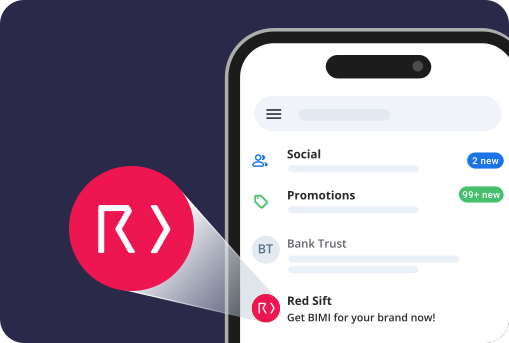
The visual impact is substantial:
When customers see your logo in their inbox:
- They immediately recognize your brand before opening the email
- Trust increases because the logo proves authentication
- Your emails stand out in crowded inboxes against competitors
- Brand recall improves by 44% [2]
Real-world results from BIMI implementation:
Research co-commissioned with Red Sift revealed concrete outcomes [2]:
- A leading US investment firm saw 9% increase in transactional email opens whilst a competitor without BIMI experienced 10% decrease
- A UK energy provider gained 38% market share (up from 6%) whilst a competitor without BIMI dropped 11%
- When comparing promotional emails, brands with BIMI saw 39% open rate uplift in UK markets and 14% in US markets
These aren't marginal improvements. They're competitive advantages that compound over time.
How DMARC and BIMI work together
Think of DMARC and BIMI as a two-stage solution:
Stage 1: DMARC (The foundation)
- Authenticates your emails are genuinely from you
- Improves deliverability by proving legitimacy to email providers
- Blocks fraudsters from impersonating your brand
- Creates the trust foundation required for logo display
Stage 2: BIMI (The visual payoff)
- Displays your verified logo next to authenticated emails
- Boosts open rates through instant brand recognition
- Differentiates your emails from competitors
- Provides visible proof your emails are trustworthy
You can't implement BIMI without DMARC at p=quarantine or (preferred) p=reject. This requirement ensures only properly authenticated brands can display logos, maintaining trust in the system.
Why authentication matters more than ever for marketing teams
Gmail, Yahoo, Microsoft and Apple are raising the bar
In February 2024, Gmail and Yahoo implemented new requirements for bulk email senders. These requirements are now industry standard and enforced across major email providers [4]:
The new baseline requirements:
- SPF and DKIM authentication for all email
- Valid forward and reverse DNS records
- Spam complaint rates below 0.3%
- Easy unsubscribe mechanisms
- Sender domain alignment
What this means for marketers:
- Unauthenticated emails increasingly get blocked or filtered to spam
- Email providers prioritize properly authenticated senders for inbox placement
- Competitors implementing authentication gain deliverability advantages
- Brands without authentication face declining open rates over time
These aren't optional guidelines. They're enforced requirements that directly impact whether your emails reach inboxes.
From November 2025, Google increased its requirements for Gmail users, ramping up its enforcement on non-compliant traffic. Messages that fail to meet the email sender requirements will experience disruptions, including temporary and permanent rejections.
The brand impersonation crisis affecting your campaigns
Cybercriminals don't just target IT systems. They target the trust you've built with customers by sending phishing emails that look exactly like your brand's communications.
The impact on marketing:
When customers receive fraudulent emails appearing to be from your brand:
- They lose trust in all communications from your company
- Future legitimate emails face higher skepticism and lower engagement
- Brand reputation suffers from association with scams and fraud
- Customer acquisition costs increase as trust rebuilds slowly
- Negative word-of-mouth spreads as victims share experiences
The scale of the problem:
- 88% of workers have opened phishing emails [1]
- Email remains the primary attack vector for cybercriminals
- Brand impersonation attacks have increased 350% year-over-year
- Average cost of brand damage from impersonation: Difficult to quantify but substantial
DMARC enforcement at p=reject prevents these attacks entirely. Fraudulent emails never reach customers, protecting both your brand reputation and customer relationships.
Your marketing stack needs authentication
Modern marketing relies on multiple platforms sending emails on your behalf:
- Email service providers (Mailchimp, HubSpot, Marketo, Salesforce Marketing Cloud)
- Marketing automation platforms
- CRM systems (Salesforce, HubSpot, Dynamics)
- Transactional email services (SendGrid, Postmark, AWS SES)
- Customer success platforms (Intercom, Zendesk)
- E-commerce platforms (Shopify, WooCommerce, Magento)
- Social media notification services
Each platform represents a potential authentication gap:
Without proper configuration, legitimate emails from your approved platforms might fail authentication checks, landing in spam. Meanwhile, unauthorized platforms could potentially send using your domain.
DMARC provides visibility into every platform sending on your behalf, ensuring all legitimate sources are authenticated whilst blocking unauthorized senders.
The hidden cost of poor deliverability
Email marketing delivers $36 ROI for every dollar spent, but only when emails reach inboxes [5]. Poor deliverability invisibly erodes this return:
Calculating the real cost:
Imagine your marketing team sends 1 million emails monthly:
- Industry average open rate: 21%
- Expected opens: 210,000
- If 30% land in spam: 630,000 reach inboxes
- Actual opens: 147,000
- Lost opportunity: 63,000 opens (30% of potential)
If each open converts at 3% with $100 average order value:
- Expected revenue: $630,000
- Actual revenue: $441,000
- Lost revenue: $189,000 monthly, $2.27 million annually
This calculation doesn't account for:
- Declining sender reputation compounding future deliverability issues
- Customers missing critical transactional emails (receipts, shipping updates, password resets)
- Abandoned customer journeys when triggered emails don't arrive
- Reduced lifetime value from customers who disengage
Proper authentication solves this invisible revenue leak.
How to boost deliverability and get your logo in inboxes
The proven path to email authentication
Marketing teams successfully implementing DMARC and BIMI follow a structured approach that protects campaign delivery whilst achieving authentication goals.
It doesn’t need to be complicated and we advise working directly with your IT and Security teams to make DMARC and BIMI a reality for your organization:
Phase 1: Discovery (Weeks 1-2)
Start by understanding your current email ecosystem:
- Audit all domains sending marketing emails
- Identify every platform sending on your behalf
- Document critical campaigns that cannot be disrupted
- Establish baseline deliverability metrics
Use free assessment tools to understand your starting point. Red Sift's Investigate tool provides comprehensive analysis in under a minute, showing:
- Current DMARC status
- Authentication gaps across sending sources
- Readiness for BMARC enforcement
- Actionable steps to improve authentication
Check your current DMARC status
Phase 2: Monitoring (Weeks 2-4)
Implement DMARC at p=none to gain complete visibility without impacting email delivery:
- Configure DMARC records for all marketing domains
- Begin receiving authentication reports
- Identify all legitimate sending sources
- Spot unauthorized sending attempts and brand impersonation
- Document which platforms need authentication configuration
During monitoring, all marketing campaigns continue normally. The p=none policy ensures zero disruption whilst gathering critical data.
Phase 3: Authentication (Weeks 4-6)
Configure proper authentication for every legitimate sending source:
- Work with ESP (Email Service Provider) and marketing automation providers to implement SPF and DKIM
- Authenticate transactional email services
- Configure CRM-generated email authentication
- Test authentication across customer journey workflows
- Resolve any configuration issues before enforcement
Most major marketing platforms provide straightforward authentication setup. Your DMARC vendor should offer specific guidance for each platform you use.
Phase 4: Enforcement (Weeks 6-8)
Gradually implement enforcement without disrupting campaigns:
- Move to p=quarantine at low percentage initially
- Monitor deliverability metrics closely
- Address any issues before expanding enforcement
- Increase percentage as confidence builds
- Progress to p=reject when authentication rates exceed 95%
This gradual approach ensures legitimate marketing emails continue flowing whilst unauthenticated (potentially fraudulent) emails get blocked.
Phase 5: BIMI Implementation (Weeks 8-10)
Once DMARC enforcement stabilizes at p=reject, implement BIMI for logo display:
- Prepare brand logo in required SVG format
- Obtain Verified Mark Certificate (VMC) from certification authority
- Configure BIMI DNS records
- Monitor logo display rates across email providers
- Measure impact on open rates and engagement
With Red Sift OnDMARC's integrated BIMI solution, this process is streamlined through partnership with Entrust, eliminating the complexity of coordinating multiple vendors [6].
Real implementation timelines
Industry average: 6+ months to reach full DMARC enforcement
With Red Sift OnDMARC: 6-8 weeks to full enforcement, 8-10 weeks to logo display [3]
This acceleration comes from:
- Automated discovery identifying all sending sources quickly
- Expert guidance preventing common mistakes that delay projects
- Real-time testing catching issues before they impact delivery
- Streamlined authentication processes for marketing platforms
- Integrated BIMI implementation eliminating vendor coordination


What to look for in a DMARC solution
Not all DMARC platforms are created equal for marketing teams. When evaluating vendors, prioritize these factors:
Speed to enforcement and logo display
- 6-8 weeks to full DMARC enforcement (vs. 6+ months industry average)
- Integrated BIMI implementation (single platform vs. coordinating multiple vendors)
- Proven track record with marketing-focused organizations
Campaign protection
- Real-time testing before policy changes impact delivery
- Automated monitoring with immediate alerts for authentication issues
- Rollback capabilities if unexpected problems arise
- Zero disruption to ongoing marketing campaigns
Ease of use for non-technical teams
- Clear dashboards showing status in simple terms (not raw technical data)
- Actionable recommendations in plain language
- Dedicated support from experts who understand marketing use cases
- Automated processes handling complex configurations
Marketing technology integration
- Comprehensive discovery identifying all sending sources
- Easy authentication setup for ESPs and marketing automation
- Ongoing monitoring ensuring configurations stay aligned
- Simple onboarding when adding new marketing platforms
Measurable results
- Deliverability tracking showing authentication impact
- Open rate analysis demonstrating BIMI effectiveness
- Sender reputation monitoring
- ROI reporting for executive stakeholders
Comparing DMARC vendors for marketers
Best for: Marketing teams seeking fastest implementation, integrated BIMI, and proven results
Key advantages:
- Industry-leading 6-8 weeks to full enforcement [3]
- Only solution with integrated BIMI and VMC provisioning [6]
- Red Sift Radar AI resolves issues 10x faster [8]
- 4.9-star G2 rating with exceptional support [9]
- Proven success with marketing-heavy brands: Domino's, ZoomInfo, Athletic Greens
- Dynamic SPF solving technical limitations without affecting deliverability [10]
- Real-time testing with Investigate feature before changes impact campaigns
Considerations:
- Custom pricing based on email volume and requirements
- Enterprise-focused (though suitable for mid-market)
Valimail
Best for: Large enterprises with complex email infrastructures
Key advantages:
- Automated authentication for many email services
- Strong enterprise features and integrations
- Established market presence
Considerations:
- Implementation timelines vary significantly
- BIMI requires coordination with separate vendors
- Steeper learning curve for non-technical marketers
PowerDMARC
Best for: Organizations working with MSP partners
Key advantages:
- AI-assisted setup capabilities
- MSP white-labeling options
- Multi-domain management
Considerations:
- Variable implementation timeline
- BIMI requires additional vendor coordination
- Support quality varies by tier
EasyDMARC
Best for: Small to mid-market companies prioritizing quick onboarding
Key advantages:
- Quick initial onboarding
- User-friendly interface
- Growing platform capabilities
Considerations:
- Newer platform still developing features
- BIMI implementation requires additional steps
- Less established market presence
Why marketing teams choose Red Sift OnDMARC
Red Sift OnDMARC has become the preferred solution for marketing-focused organizations seeking email authentication without campaign disruption. Several factors distinguish Red Sift for marketing use cases:
Fastest path to logo display in customer inboxes
Marketing teams implement DMARC specifically to unlock BIMI logo display. Red Sift delivers this outcome faster than any competitor through:
- Guided implementation reaching p=reject in 6-8 weeks (vs. 6+ months industry average)
- Integrated BIMI and VMC through Entrust partnership [6]
- Single platform eliminating multi-vendor coordination
- Streamlined processes designed for marketing timelines

Zero risk to campaign performance
Marketing teams cannot tolerate email delivery disruptions. Red Sift's methodology protects campaigns throughout implementation:
- Comprehensive discovery before enforcement changes
- Real-time testing catching issues before they impact delivery
- Continuous monitoring with immediate alerts
- Expert guidance from customer success managers
- Rollback capabilities for unexpected situations
This protection isn't theoretical. Customers consistently report maintaining deliverability whilst achieving authentication goals.
Built for marketers, not engineers
Red Sift OnDMARC is designed for marketing professionals without technical backgrounds:
- Dashboards showing authentication status in simple visual terms
- Plain-language explanations and recommendations
- Dedicated customer success managers who understand marketing priorities
- Automated processes handling technical complexity behind the scenes
- Responsive support for urgent issues affecting campaigns

Proven results with marketing-heavy brands
Red Sift's customer base includes organizations where email marketing drives revenue:
- Domino's: High-volume promotional emails for food delivery
- ZoomInfo: B2B marketing platform with extensive email operations
- Athletic Greens: Direct-to-consumer brand dependent on email marketing
- Wise: Financial services achieving 99% deliverability
These organizations chose Red Sift specifically because authentication and deliverability directly impact revenue.
Measuring the marketing impact of DMARC and BIMI
Deliverability improvements you can expect
Organizations implementing full DMARC enforcement consistently report measurable deliverability improvements:
Primary metrics:
- Inbox placement rates: 90-99% (vs. 70-80% without authentication)
- Spam folder reduction: 60-80% decrease in spam classification
- Sender reputation scores: Consistent improvements across ESPs
- Authentication pass rates: 95%+ for legitimate emails
Customer example: Wise achieved 99% email deliverability after implementing DMARC enforcement with Red Sift OnDMARC [15].
BIMI's impact on engagement metrics
Research co-commissioned by Red Sift measured concrete outcomes from BIMI implementation [2]:
Open rate improvements:
- 39% increase for UK organisations
- 21% increase for US organizations
- 9% increase for transactional emails (US investment firm)
- 14-39% uplift for promotional emails
Brand metrics:
- 44% boost in brand recall
- 38% market share increase (UK energy provider)
- 90% increase in consumer confidence in sender legitimacy
Competitive advantage:
- Leading brands without BIMI lost 15-18% share of opens to competitors with BIMI
- Smaller brands with BIMI outperformed larger competitors without it
These improvements compound over time as customers develop stronger brand associations with your logo display.
Metrics to track during implementation
Week 1-2 (Discovery):
- Number of email-sending platforms identified
- Percentage of email volume by source
- Current authentication pass rates
- Baseline open rates and deliverability
Week 2-4 (Monitoring):
- Authentication pass rate trends
- Unauthorized sending attempts identified
- Platforms requiring authentication configuration
- No impact to deliverability metrics (validation of p=none)
Week 4-6 (Authentication):
- Percentage of volume properly authenticated
- Authentication pass rates by platform
- Deliverability metrics (should remain stable or improve)
- Issues identified and resolved
Week 6-8 (Enforcement):
- DMARC enforcement percentage
- Emails quarantined or rejected
- Deliverability to primary inbox
- Open rates and engagement metrics
- Sender reputation scores
Week 8-10 (BIMI):
- Logo display rates by email provider
- Open rate changes vs. pre-BIMI baseline
- Brand recall surveys (if conducted)
- Competitive comparison (your logo vs. competitors without)
Addressing common marketing concerns
"Will this disrupt our email campaigns?"
This is the number one concern marketing teams raise, and it's valid. Email marketing drives revenue, so any risk to deliverability creates anxiety.
The reality: Properly implemented DMARC and BIMI improve campaign performance rather than disrupt it.
The key is following a phased approach:
- Start with monitoring (p=none) for complete visibility without risk
- Authenticate all marketing platforms before enforcement
- Test thoroughly using real-time testing tools
- Progress gradually from quarantine to reject
- Monitor continuously with ability to rollback if needed
Organizations implementing Red Sift OnDMARC consistently achieve full enforcement in 6-8 weeks without any disruption to marketing operations [3]. The guided approach ensures legitimate emails continue flowing whilst fraudulent messages get blocked.
Customer validation: Dozens of marketing-heavy brands including Domino's, ZoomInfo, and Athletic Greens have implemented without campaign disruption.
"Our team isn't technical enough to manage this"
Marketing professionals shouldn't need to become email security experts. The right solution handles technical complexity whilst providing clear, actionable information.
What "non-technical friendly" actually means:
- Dashboards showing authentication status in visual, simple terms
- Recommendations in plain language (not technical jargon)
- Automated processes handling complex configurations
- Dedicated support answering questions without assuming technical knowledge
- Real-time testing letting you preview changes before implementation
"How long will implementation really take?"
Industry averages suggest 6+ months for DMARC implementation, but this timeline reflects organizations struggling without proper guidance and automation.
With Red Sift OnDMARC: 6-8 weeks to full DMARC enforcement, 8-10 weeks to logo display [3]
This acceleration comes from:
- Automated discovery identifying all sending sources in days (not months)
- Expert guidance preventing common mistakes that cause delays
- Real-time testing catching issues before they impact delivery
- Streamlined processes for marketing platform authentication
- Integrated BIMI eliminating multi-vendor coordination
Translation for marketing teams: You can be displaying your logo in customer inboxes within 2-3 months rather than waiting 6+ months.
"What about our ESP's built-in DMARC tools?"
Many email service providers offer basic DMARC monitoring, but these tools have significant limitations for marketing teams:
What ESP tools typically offer:
- Monitoring for emails sent through their platform only
- Basic reporting on authentication status
- Limited guidance on reaching enforcement
What ESP tools typically lack:
- Visibility into other marketing platforms you use
- Monitoring for unauthorized sending attempts
- Expert guidance on authentication strategy
- Real-time testing before policy changes
- BIMI implementation support
- Cross-domain management for multi-brand organizations
The bottom line: ESP tools provide starting point visibility but cannot deliver full authentication benefits marketing teams need.
Comprehensive platforms like Red Sift OnDMARC provide complete visibility across all sending sources, guided enforcement, and integrated BIMI implementation that ESP solutions cannot match.
"How do we know customers will even notice the logo?"
The logo displays automatically in supported email providers without any action from customers. However, the impact is measurable through engagement metrics.
What customers see:
- Your verified brand logo next to emails in Gmail, Yahoo, Apple Mail
- Consistent visual branding before opening messages
- Trust signals proving emails are authenticated
What happens to engagement:
- 39% increase in open rates (UK organisations) [2]
- 21% increase in open rates (US organizations) [2]
- 44% boost in brand recall [2]
- 90% increase in consumer confidence in sender legitimacy [2]
These aren't speculative benefits. They're measured outcomes from organizations that implemented BIMI.
The competitive angle: When your emails display logos and competitors' don't, you stand out in crowded inboxes. Research shows brands with BIMI gained 14-39% open rate advantages over competitors without logo display [2].
"What if our brand gets impersonated despite DMARC?"
DMARC at p=reject enforcement prevents exact domain impersonation (emails appearing to be from yourbrand.com). However, attackers might use lookalike domains (yourbrand-special.com or yourbran.com).
For complete brand protection, combine DMARC with:
- Brand monitoring to identify lookalike domain registrations
- Takedown services to remove fraudulent domains quickly
- Customer education about verifying email authenticity
Red Sift offers Brand Trust, which monitors 150 million newly registered domains daily to identify lookalike threats, provides AI-powered classification of impersonation intent, and includes integrated takedown services [11].
Many organizations implement DMARC first for deliverability and logo display, then add brand monitoring for comprehensive protection.
The bottom line for marketers
Email authentication through DMARC isn't just a security requirement. It's a competitive advantage that directly impacts marketing performance.
The evidence is clear:
- 39% increase in email open rates with BIMI implementation [2]
- 99% deliverability rates protecting marketing investment
- Complete brand protection preventing customer trust erosion
- Competitive differentiation through visible trust signals
Yet most marketing teams still haven't implemented proper authentication, creating opportunity for forward-thinking brands to gain measurable advantages.
Three things successful marketing leaders understand:
- Email deliverability is a revenue driver, not just a technical metric. Every percentage point improvement in inbox placement translates directly to additional opens, clicks, and conversions.
- Logo display is the new email marketing competitive advantage. In crowded inboxes, visual brand recognition creates instant differentiation that drives engagement.
- Authentication protects years of brand-building investment. Preventing impersonation attacks preserves customer trust and brand reputation that took years to establish.
The vendors you choose matters significantly. Marketing teams should prioritize solutions offering:
- Fastest implementation protecting campaign timelines (6-8 weeks vs. 6+ months)
- Integrated BIMI eliminating multi-vendor coordination complexity
- Non-technical usability with expert support understanding marketing priorities
- Proven results with similar marketing-heavy organizations
Red Sift OnDMARC delivers on all these requirements, providing the fastest path to authentication, deliverability improvements, and logo display whilst protecting campaign performance throughout implementation [3].
Ready to boost email performance and get your logo in every inbox?
Start with a free assessment
Discover your current authentication status and get personalized recommendations in under a minute.
Check your email authentication for free →
See how it works for marketing teams
Book a personalized demo showing how Red Sift OnDMARC protects campaigns, accelerates logo display, and delivers measurable improvements to email performance.
Learn more about logo display benefits
Explore our comprehensive BIMI guide showing how displaying verified logos boosts open rates, enhances brand recall, and creates competitive advantage.
References
[1] TechMagic. (2025). "Phishing Statistics in 2025: The Ultimate Insight." https://www.techmagic.co/blog/blog-phishing-attack-statistics
[2] Red Sift. (2025). "What is Brand Indicators for Message Identification (BIMI)?" https://redsift.com/guides/email-security-guide/bimi
[3] Red Sift. (2025). "Top DMARC Vendors 2025." https://redsift.com/guides/top-dmarc-vendors-2025
[4] Red Sift. (2024). "Google and Yahoo's New Email Authentication Requirements." https://redsift.com/blog/email/google-yahoo-new-email-requirements/
[5] Litmus. (2023). "Email Marketing ROI Statistics." https://www.litmus.com/blog/email-marketing-roi/
[6] Red Sift. (2025). "Display your logo on every email you send with BIMI by OnDMARC." https://redsift.com/pulse-platform/ondmarc/bimi
[7] Red Sift. (2024). "TalkTalk Case Study." https://redsift.com/resource-center/case-study/talktalk
[8] Red Sift. (2024). "Meet Red Sift Radar: AI-powered security issue resolution." https://blog.redsift.com/product/meet-red-sift-radar/
[9] Red Sift. (2025). "Europe's #1 for DMARC: Red Sift OnDMARC does it again." https://redsift.com/blog/europes-1-for-dmarc-red-sift-ondmarc-does-it-again
[10] Red Sift. (2025). "Why choose Red Sift for your email security?" https://redsift.com/guides/email-security-guide/why-choose-red-sift
[11] Red Sift. (2025). "Introducing Brand Trust: monitoring & takedown." https://redsift.com/blog/introducing-brand-trust-quickly-uncover-and-take-down-phishing-sites
Get started now with a short demo