
Know what to do next in less time with Radar Agents
Bad actors are already using AI to cover more ground to exploit your business. What’s stopping you from doing the same to protect yourself? Red Sift Radar’s Agents sit seamlessly in the apps you use most across the Pulse platform, providing context and guidance when and where you need it.

Bad actors are already using AI to cover more ground to exploit your business. What’s stopping you from doing the same to protect yourself? Red Sift Radar’s Agents sit seamlessly in the apps you use most across the Pulse platform, providing context and guidance when and where you need it.
The threat businesses face today is overwhelming, and it’s not hard to see why when you face the facts:
Verizon’s latest DBIR notes that attackers, on average, use AI in 15 different ways to build their attack surface.
With the introduction of AI, Gartner notes that the attack cost dropped by 95%.
Dark web LLMs are designed to spin up attack campaigns in minutes, enabling attackers to do more in less time.
Red Sift Radar’s Agents close that gap by conducting the investigation directly within the tools your team already has open, with your entire account in context, rather than a canned, generic answer scraped from the web.
AI source classification
AI Classifier evaluates DMARC sources against a broader dataset than traditional if/then logic. You get a confidence score and a context-rich recommendation instead of a flag with no explanation.
Issue identification
Get exact context for any given Certificates issue within the application itself, with all of the information you need to make the judgment call.
Remediation guidance
Every recommendation is grounded in your account's actual data and configuration, not a generic best-practice checklist.
Why security teams choose Radar Agents
Better coverage without the footwork
Radar Agents take on the review work that would otherwise pile up on an analyst's desk, so lean teams can do more in less time.
Time back, not just faster clicks
Manual source review across multiple sources used to take hours. With Radar Agents built into the workflow, that's closer to minutes of work.
Answers tied to your account, not a guess
Because Radar Agents evaluate your actual data, the classification and remediation guidance you get fits the issue in front of you instead of a generic if/then rule.
Easier to explain to everyone else
Radar Agents generate plain-language explanations your IT team, leadership, or outside vendors can actually use, so you're not the only translator between the alert and the fix.

“With Radar, [my threat analysis] process has been streamlined, reducing the time to approximately 2 minutes per domain.”

“In the first 24 hours of use, Radar saved us $4,000 by identifying a fraudulent invoice from its header information.”


“Radar gives us a quick and easy way to not only check the configurations, but also to provide IT professionals with excellent documentation and explanations of the problem, along with information to fix the issue.”

“Radar helped me identify an opportunity to tighten security around one of my email domains with an MTA-STS policy. It explained why the policy is important, walked me through the steps to configure and enable it, and even verified that I had everything configured correctly afterward. Incredibly helpful!”

“With Radar, [my threat analysis] process has been streamlined, reducing the time to approximately 2 minutes per domain.”
FAQ
AI agents built directly into Red Sift. They give analysts account-aware answers on classification, threat detection, and remediation right inside the products you already use.
General LLMs answer from public information. They don't see your account, DMARC records, or configurations as Radar does. Unless you're connecting them through our MCPs, you're getting generic answers that might not relate to what you’re seeing in the data.
It evaluates DMARC sources against a broader dataset rather than traditional if/then logic. That gets you higher-confidence classification scores plus context on why, not just a pass or fail flag.
Speed them up. Radar Agents take on the review work that would otherwise pile onto an analyst's plate, so lean teams cover more ground without adding headcount or new tools.
Keep the manual workstream going, or paste account data into a general LLM. A general LLM without a live connection to your account is working off partial information and can hallucinate.
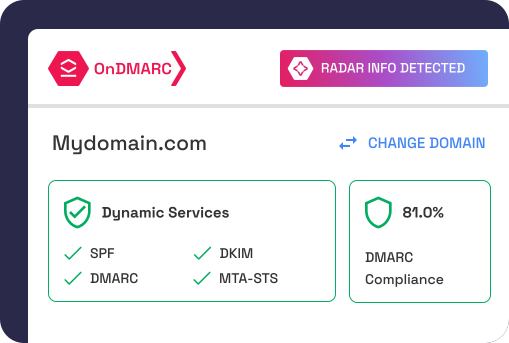
See how Radar finds and fixes security issues 10x faster across the Pulse platform.
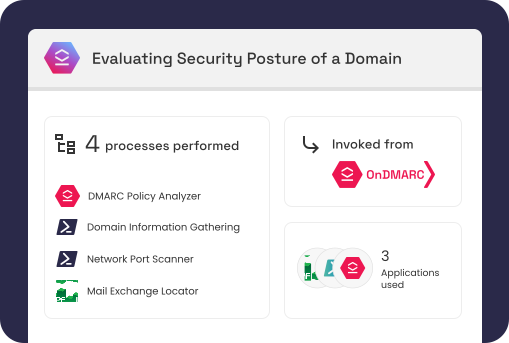
Bring Radar into Claude and ChatGPT with a live connection to your account data.

Find out how teams like FHC use Radar to investigate threats faster.
Stop reviewing sources one at a time.
See what Radar Agents can classify and fix in your account today.